
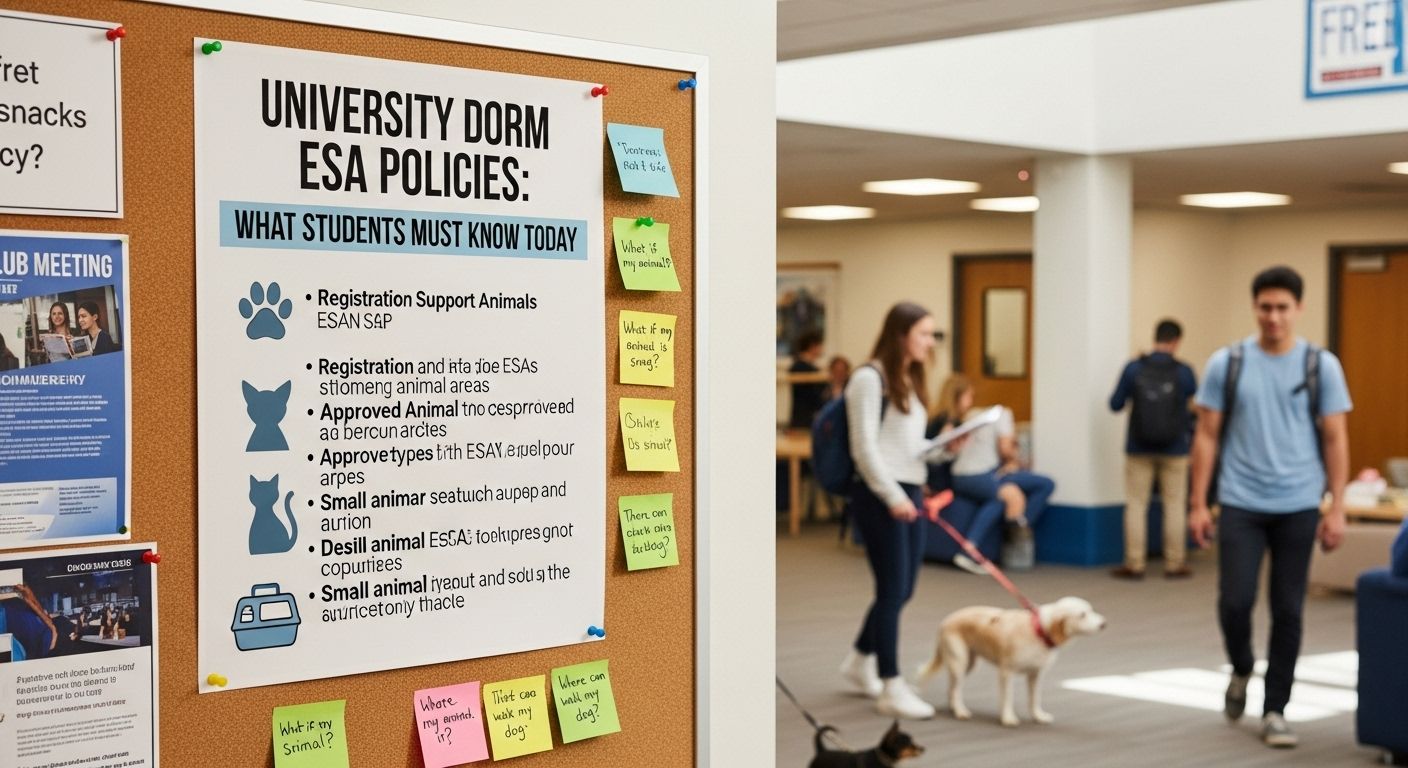
We know that starting college is one of the biggest changes you will ever go through. You are leaving home, often for the first time, and moving into a small space with people you don't know. For many students, this creates a lot of stress and big feelings like anxiety or sadness. We want you to know that you do not have to handle these feelings all by yourself. Emotional support animals, or ESAs, have become a very important part of how students manage their mental health while living on campus.
An emotional support animal is a companion that a doctor says helps you with a mental or emotional disability. They are not like regular pets because they serve a real health purpose. For example, if you have panic attacks, having your cat there to sit on your lap can help you breathe and feel safe again. We have seen how these animals can help a student stay focused on their classes because they feel less lonely in their dorm room.
The rules for having an animal in a dorm used to be very strict. Most schools just said "no pets allowed" and that was the end of it. But things are different now. Schools have learned that mental health is just as important as physical health. They have to follow laws that protect your right to have a support animal in your campus home. This process can feel like a lot of work, but we are here to help you understand every step.
If you are just starting to look into this, RealEsaLetter is a place where you can find out more about how to get the right documentation. We want to make sure you have all the information you need before you even pack your bags. In this guide, we are going to look at why schools have to allow ESAs and how you can make sure your animal is welcome in your dorm. We will talk about everything from the laws to how to keep your room clean.
How federal housing law applies to campus residences
We need to talk about the laws that protect you. The biggest one is the Fair housing act. This is a federal law that makes it illegal for housing providers to discriminate against people with disabilities. You might think of your dorm as a school building, but the law sees it as a "dwelling." Because you live there, eat there, and sleep there, it counts as housing. This means the school has to follow the same rules as an apartment building would.
The government department that watches over these rules is called HUD. They have stated very clearly that universities must allow students to have assistance animals if they are needed for a disability. A "reasonable accommodation" is what we call it when a school changes its "no pets" rule for a student who needs an ESA. They cannot charge you extra money like a pet deposit or monthly pet rent because your animal is not a pet in the eyes of the law.
- The law applies to public and private universities that receive federal funding.
- Schools cannot ban specific breeds or sizes of animals in their housing.
- The Fair Housing Act protects students with both physical and mental health conditions.
- Housing offices must look at each request individually rather than using a blanket rule.
We have seen many cases where schools tried to say their dorms were too small for animals. But the courts have said that size does not matter as much as the student's health. As long as the animal does not cause a "direct threat" to other people or cost the school a huge amount of money to manage, it must be allowed. We want you to feel strong knowing that the federal government is on your side when it comes to living with your support animal.
Differences between dorms, campus apartments, and classrooms
It is very important to understand that your ESA's rights are mostly about where you live. An ESA is allowed in your dorm room and the common areas of your housing building, like the hallways or the laundry room. However, they do not have the same rights as service animals to go into every building on campus. You cannot usually take your support animal to your biology lecture, the campus library, or the student union building.
We often get questions about taking animals into local stores or businesses near campus. For example, people wonder are dogs allowed in ace hardware or other shops. Those places have their own rules because they are not housing. On campus, the classrooms are academic spaces, and the law does not require the school to let ESAs in there. If you want to take an animal into a classroom, it usually has to be a trained service dog that helps with a physical task.
Campus apartments are a bit different because they often have their own separate entrances. If you live in an apartment owned by the school, the same Fair Housing rules apply as in a dorm. You still have to go through the disability office to get approval. Some schools have special "pet-friendly" dorms, but you should not have to live only in those buildings if you have a legitimate ESA request for a regular dorm.
The goal of these rules is to balance your needs with the needs of the whole campus. Some students might have severe allergies or fears of animals, and they have to be able to go to class without being worried. By keeping ESAs in the housing areas, the school makes sure you have your support where you need it most, while keeping the shared learning spaces open for everyone. We suggest always asking your housing office for a map of exactly where your animal can go so you don't get in trouble.
ESA vs service animal rules on campus
We see a lot of confusion between what an ESA is and what a service animal is. It is very important to use the right words when talking to your school. A service animal is almost always a dog that has been professionally trained to do a specific job. This could be a dog that helps a blind student walk across campus or a dog that detects when a student is about to have a seizure. These animals are covered by a law called the ADA.
An ESA is different because they do not need any special training. Their job is to provide comfort through their presence and their bond with you. We often see ESAs helping veterans PTSD in deep and meaningful ways, but they are still categorized as ESAs if they aren't trained for a physical task. Because they aren't trained for public work, they don't have the same access to "public" places like the cafeteria.
- Service animals can go anywhere the public is allowed to go.
- ESAs are primarily restricted to the student's assigned housing.
- Schools can ask for documentation for an ESA but generally cannot for a service animal.
- A service animal must be a dog or a miniature horse, but an ESA can be many types of animals.
When you apply for housing, the school will ask which type of animal you have. If you tell them your dog is a service animal, they might ask what task it does. If you say it just makes you feel better, they will tell you that it is an ESA. We want you to be honest because if you call an ESA a service animal to get them into a dining hall, the school might see it as fraud. Knowing the difference helps you follow the rules and keep your animal with you legally.
What documentation universities may request from students
When you ask for an ESA, the university is allowed to ask for a letter. This is the most important part of your application. The letter must come from a licensed health professional who knows you and your health. If you are going to school in a specific area, you should check the local rules. For example, if you are in the Great Lakes area, you might need an esa letter michigan that follows the specific standards of that region.
Universities have become much more careful about the letters they accept. They want to make sure the doctor or therapist is real and has actually talked to you. Some states have passed laws to stop people from just buying a letter from a website without seeing a doctor. It is a good idea to look up the michigan esa laws if you are attending a school there, as they have strict rules about who can write these documents.
- The letter should be on the professional's official office letterhead.
- It must state that you have a disability that limits a major life activity.
- It should explain how the animal helps reduce the symptoms of your condition.
- The professional should include their license type and number.
We recommend getting your letter from a person you have been seeing for a while. This could be your therapist from back home or a doctor you see at the campus health center. Schools may also ask for your animal's health records. They want to see that your pet has all their shots and is healthy. This helps keep everyone in the dorm safe. We suggest keeping a folder with all these papers in it so you are ready whenever the school asks for updates.
Timing issues when requesting ESA accommodations
One of the biggest mistakes we see students make is waiting until the last minute. If you wait until you are moving in to tell the school about your ESA, they will probably tell you to leave the animal at home. The housing office needs time to look at your letter and make a plan. We have noticed that ESA approval rates by state can change, and some schools are much slower than others. We suggest starting the process at least sixty days before the semester begins.
Most schools have a specific deadline for "accommodation requests." This is usually the same time that you pick your dorm room or find out who your roommate is. If you miss this deadline, the school might still let you have the animal, but they might not be able to put you in the building you want. They might have to move you to a different room where there aren't any students with allergies. This can be very stressful if you already had your heart set on a certain dorm.
- Check the housing website for deadlines as soon as you get accepted.
- Submit your paperwork early so there is time to fix any mistakes.
- Don't bring the animal to campus until you have a final email saying "yes."
- Keep in mind that the start of the year is the busiest time for the housing staff.
If you decide you need an ESA in the middle of the school year, you can still apply. You don't have to wait until next August. But you must be patient. It might take two or three weeks for the disability office to meet and talk about your file. During this time, you should find a safe place for your animal to stay, like at your parents' house or with a friend off-campus. We have seen students get in big trouble for "sneaking" an animal in while they were waiting for approval.
Common dorm policy conflicts with ESAs
Living in a dorm means living with a lot of other people in a very small space. This can lead to some arguments. The most common conflict is with roommates. Some people are very allergic to cats or dogs. Other people might be afraid of them. If your roommate has a medical reason why they cannot live with an animal, the school will have to move one of you. We suggest talking to your roommate as soon as you are assigned to each other so there are no surprises.
We also see conflicts about noise and cleanliness. Dorm walls are thin. If your dog barks every time someone walks by in the hallway, your neighbors will get upset. We often look at how animals behave in public places, like are dogs allowed in arches national park where rules are very strict. In a dorm, the rules are even tighter. If your animal is making too much noise or making the room smell bad, the school can actually tell you that the animal has to leave.
- You are responsible for picking up all waste and cleaning it up immediately.
- The animal cannot be left alone in the room for more than a few hours.
- You cannot wash your animal in the shared student showers.
- The animal must be well-behaved and not aggressive toward anyone.
We also find that other students might get jealous or annoyed. They might think you are just getting a "pet" when they aren't allowed to have one. We suggest being very polite but firm about your animal's role. You don't have to tell everyone your medical history, but you can say that the animal is a pre-approved support animal. Keeping your animal clean and quiet is the best way to stop these conflicts before they even start.
Housing office review processes explained
Once you turn in your letter, it goes through a review process. Usually, the office of disability services looks at the letter first. They want to make sure it meets all the legal requirements. They are the ones who decide if you have a "qualifying disability." We are seeing that the Fur baby generation ESA rights are becoming a big topic, which means these offices are getting a lot of requests. They have to be very organized to handle them all fairly.
After the disability office says your request is valid, they send a message to the housing department. The housing staff then looks at where you are living. They check to see if your roommates are okay with it and if the room is big enough for the animal you want to bring. This is called the "interactive process." They might email you to ask how you plan to take care of the animal or if the animal has ever bitten anyone.
- The committee might meet once a week to review new requests.
- They will confirm your professional's license is active and valid.
- They will check to see if there are any "health-safe" floors nearby.
- You will receive a formal agreement to sign before the animal moves in.
We want you to know that this is not a test. They aren't trying to "catch" you. They are just trying to make sure that the dorm stays a safe place for everyone. If they have questions, answer them quickly and honestly. We have found that the students who are the most helpful during the review process are the ones who get approved the fastest. Once you sign the final agreement, you are officially allowed to bring your animal home.
When schools improperly deny ESA requests
Sometimes, a school might say no when they should have said yes. We have seen schools deny requests for reasons that are not legal. For example, some schools try to say that only "small" animals like hamsters are allowed. But the law says that any common household animal can be an ESA if it helps with a disability. If a school tells you that you can't have a dog because of a weight limit, they might be breaking the law.
We also see schools try to add rules that are not allowed. Some schools try to tell you are dogs allowed in best buy or other stores to make a point about where animals go, but they can't use those public rules to limit your rights in your own home. If they try to charge you a fee just to look at your application, that is also a big problem. You should not have to pay extra money to have your rights respected.
- Denying an animal because of its breed (like Pit Bulls or Huskies).
- Saying you can't have an ESA because you live in a "premium" dorm.
- Telling you that you have to use a specific website to register your animal.
- Claiming that "too many" people in the building already have ESAs.
If your school gives you a reason like this, they are making a mistake. The law does not allow for "quotas" or breed bans in housing. Each request must be looked at on its own. We have seen schools change their minds once a student points out the federal guidelines. If you feel like you are being treated unfairly, it is important to speak up. You have the right to a fair process, and the school cannot just make up their own rules that go against federal law.
Steps students should take if accommodation is refused
If your school says no to your request, don't give up right away. The first thing you should do is ask for the denial in writing. You want to see exactly why they made that choice. If they say your doctor's letter was missing something, you can go back to your doctor and get a new one. This is the easiest way to fix the problem. We suggest being very calm and professional when you ask for these details.
If the school is being stubborn and their reason seems illegal, you can file an appeal. Most colleges have a formal way to do this. You might have to write a letter to the Dean of Students or a special committee. In this letter, you should explain why you need the animal and how the school's denial is hurting your ability to learn. We have seen that many students win their appeals when they show they are serious and know the laws.
- Ask for a meeting with the director of disability services.
- Bring a copy of the HUD guidelines on assistance animals to your meeting.
- Talk to your student legal services office if your campus has one.
- Consider filing a complaint with the Department of Education or HUD.
If the school still won't listen, you have the right to look for help outside of the university. You can file a complaint with a government agency for free. They will investigate the school and see if they are breaking the Fair Housing Act. This can take a few months, but it is a very powerful way to protect your rights. You should also look for disability advocacy groups in your state. They often have lawyers who can give you advice for free or for a low cost.
Role of disability services and housing departments
We want you to understand that you will be working with two different groups of people at your school. The Disability Services office is there to help you. Their whole job is to make sure that students with health issues have what they need to succeed. They are usually very kind and understand a lot about mental health. They are the ones who look at your private medical letter. They are not allowed to share your diagnosis with the housing office.
The Housing Department is more focused on the building and the other students. They are the ones who manage the rooms and the RAs. Once Disability Services says you qualify for an ESA, the Housing office takes over the "logistics." They are the ones who will talk to you about where you will walk your dog or how you will dispose of kitty litter. It is important to be nice to the housing staff because they are the ones who will be checking on your room.
- Disability Services decides if you have a medical need for the animal.
- Housing decides which room is the best fit for you and the animal.
- Both offices must keep your information confidential and private.
- You should get a contact person in both offices so you know who to call.
Sometimes these two offices don't talk to each other very well. You might get a "yes" from one and then get a confusing email from the other. If this happens, don't get frustrated. Just send a polite email to both offices and ask them to help you understand the next step. By being organized and staying on top of your emails, you can make sure that nothing falls through the cracks. We have seen that the most successful students are the ones who act as their own "project manager" during this process.
How privacy and confidentiality are handled
We know that many students are worried about their privacy. You might be worried that everyone on your floor will find out that you have a mental health condition. We want to reassure you that the school has to follow very strict privacy laws. These laws are called FERPA and HIPAA. They mean that the school cannot tell your professors, your neighbors, or even your RA why you have an animal. They can only tell people that the animal is an "approved accommodation."
When your roommates are notified, the school will usually send a very general letter. It will say that someone in the room has an assistance animal. It will not use your name or your condition. This gives you the choice to tell your roommates as much or as little as you want. You are in control of your own story. We have seen some students who are very open about their ESA, and others who prefer to keep it a secret. Both choices are okay.
- Your doctor's letter is kept in a secure file in the disability office.
- Only a few staff members will ever know the details of your health.
- You do not have to explain your disability to your roommates if you don't want to.
- The RA is only told that the animal is allowed to be there.
We suggest thinking about what you want to say before you move in. People will see you with your animal and they will be curious. You can just say, "This is my support animal, and they are allowed to live here with me." You don't have to give any more details than that. If anyone keeps pushing you for more information, you can tell them that your medical history is private. The school is required to back you up on this and protect your privacy at all times.
Preparing for move-in with an ESA
Moving into a dorm is a big deal, and moving in with an animal takes even more planning. We suggest making a "dorm kit" for your animal. This should include all the basics like food, bowls, and a bed. But it should also include things to help with the unique challenges of a dorm. Since rooms are small, you might want to get a "top-entry" litter box to keep smells down or a white-noise machine to help your dog stay calm when people are loud in the hallway.
You should also check the room for safety. Dorm furniture is often made of wood that dogs might want to chew. You might want to bring some "bitter spray" to protect the desk legs. You should also look for small spaces where a cat might get stuck, like behind the heavy wardrobes. Making the room safe for your animal will help them feel at home much faster. We have seen that animals who feel safe are much quieter and better behaved.
- Bring a portable vacuum to keep the fur and dander under control.
- Pack a first-aid kit for your animal just in case.
- Bring several toys to keep the animal busy while you are in class.
- Have a copy of your approval letter taped to the back of your door.
We also suggest finding a vet near campus before you move. You don't want to be searching for a doctor if your animal gets sick in the middle of the night. Save the number of the nearest emergency vet in your phone. It is also a good idea to find a "designated helper." This is a friend on campus who knows your animal and can help out if you have an emergency or get stuck in a long lab. Having a plan makes everything go much smoother for you and your furry friend.
Key takeaways for students navigating ESA dorm policies
As you get ready for your college journey, we want to remind you that having an ESA is a wonderful way to support your mental health. It is not always easy to navigate the rules, but it is worth it to have your companion by your side. We have seen how a support animal can turn a stressful dorm room into a true home. By following the laws and being a responsible owner, you are making it easier for yourself and for other students who will come after you.
The most important things to keep in mind are timing and documentation. Get your letter early and make sure it is from a real professional who knows you well. Follow all the deadlines set by your school so you don't have to deal with any last-minute stress. Remember that your rights are protected by the Fair Housing Act, but you also have the duty to make sure your animal is a good citizen of the dorm.
We hope this guide has given you the confidence you need to talk to your university. Don't be afraid to ask for what you need. College is a time for learning and growing, and you deserve to have the support that helps you do your best. We wish you and your ESA a fantastic school year filled with good grades and lots of comfort. Keep your head up, follow the process, and enjoy the special bond you have with your animal. You have the rights, the tools, and the plan to make this work. Good luck with your studies and your move-in day.
See More Related Blogs:
San Francisco ESA Condo Rights City Housing Market Navigation
Florida Condo ESA Laws July 2020 State Law Explained